Bakery Fillings & Inclusions

Application overview

Concentrated fruit character with controlled water addition

Juice concentrates give bakery formulators a practical way to add fruit flavor, soluble solids, naturally occurring sugars, organic acids and plant-derived color while introducing substantially less water than single-strength juice.

That lower-water format can be useful in pastry fillings, fruit bars, cookies, doughnuts, cake layers, cheesecake swirls and other systems where excessive water can increase cook-down time, soften surrounding bakery structure or make bake stability more difficult to control.

Concentrate is normally one component of the finished system rather than a complete filling. Starch, pectin, puree, fruit pieces, sweeteners, fibers or other ingredients may be used to create the required body, texture and moisture control.

Choose the ingredient format by function

Use concentrate when the primary objectives are fruit intensity, soluble solids, acidity or color with limited water. Use puree when greater body and pulp are required, and IQF fruit where visible fruit pieces are central to the product.

Qualification reminder: Juice concentrates are agricultural ingredients. Fruit variety, crop, origin and processing can affect Brix, acidity, color, flavor and commercial availability. Final approval should use the current specification and representative commercial sample.
Fruit profiles

Representative concentrates for bakery development

Fruits with similar concentrate Brix can differ considerably in acidity, aroma and color. The examples below are representative commercial references rather than fixed PFVN purchasing specifications.

Raspberry High-impact berry & pronounced acidity

Raspberry provides vivid red-berry aroma and acidity that can remain recognizable against sugar, chocolate, dairy and baked cereal matrices.

Representative concentrate is around 65° Brix, pH approximately 2.1–3.6, with acidity commonly reported as citric acid and a single-strength reference near 9.2° Brix.

Blueberry Dark berry with rounded fruit character

Blueberry provides purple-red color and a softer berry profile than raspberry or blackberry. It works particularly well with oats, vanilla, lemon, cheesecake and mixed berries.

Commercial examples are around 65° Brix, pH approximately 1.8–3.4, with a single-strength reference near 10° Brix.

Blackberry Rich dark berry & strong acid contribution

Blackberry delivers deep color, pronounced berry aroma and substantial acidity. It can be useful where a relatively small dose needs to remain noticeable after baking.

Representative concentrate is around 65° Brix, pH approximately 2.0–3.7, with a single-strength reference near 10° Brix.

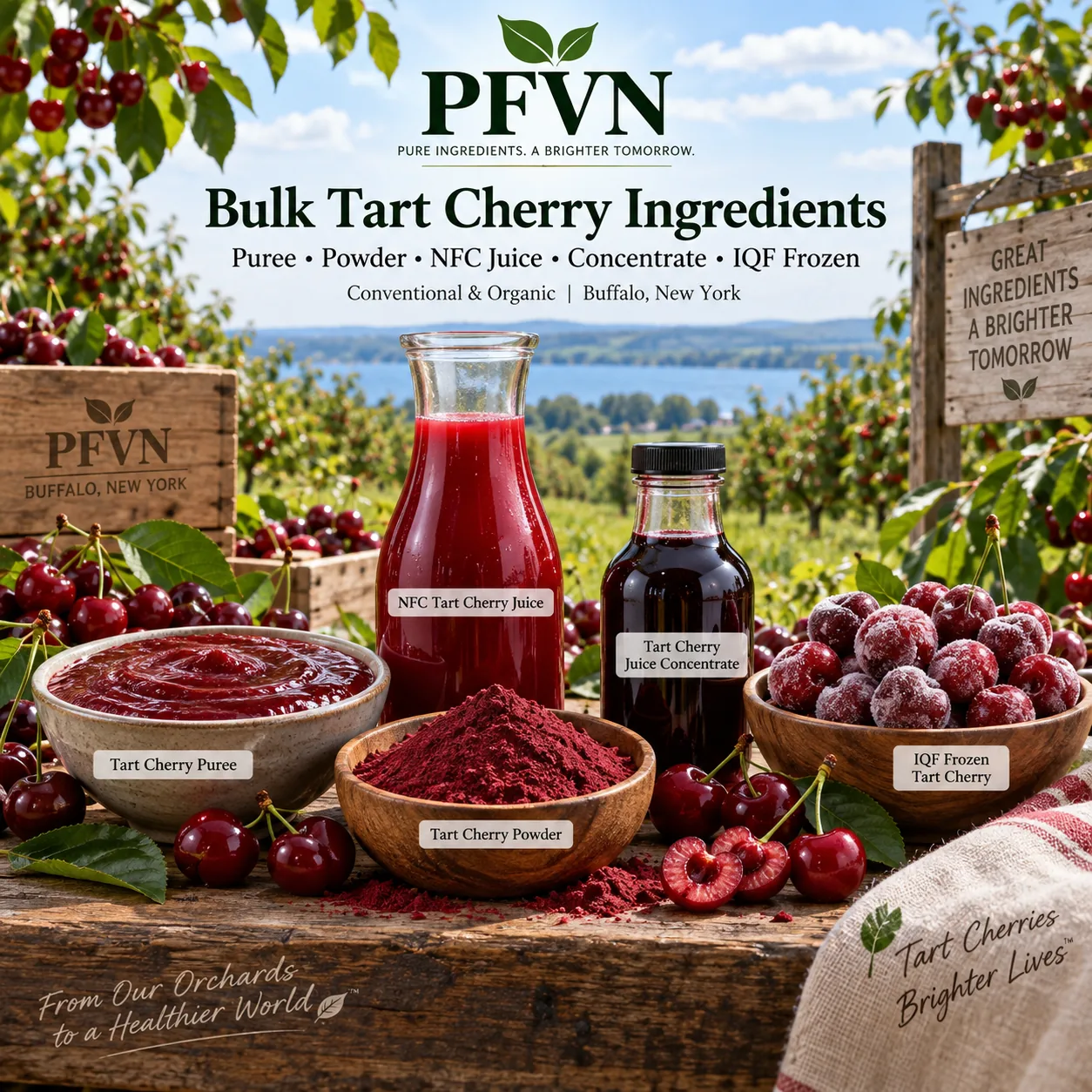
Tart cherry Bright cherry & malic-acid character

Tart cherry provides recognizable sour-cherry flavor and strong red-fruit identity. It performs well in pastries, fruit bars, chocolate pairings and seasonal bakery concepts.

Representative sour cherry concentrate is around 65° Brix, pH approximately 2.6–4.2, with acidity commonly expressed as malic acid and a single-strength reference near 14° Brix.

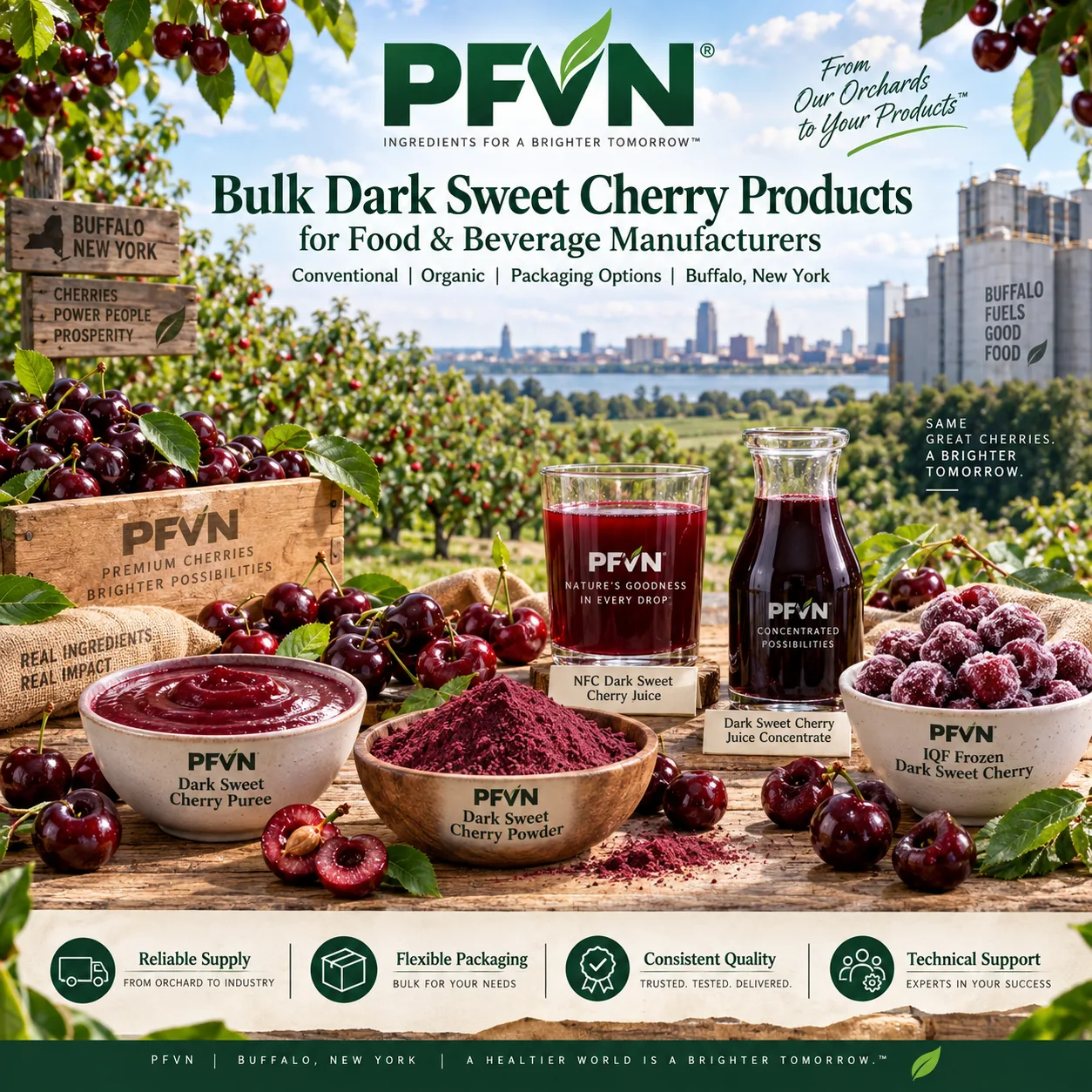
Dark sweet cherry Rounder flavor & higher natural solids

Dark sweet cherry is less sharp than tart cherry and provides a deeper, sweeter cherry character suited to chocolate, almond, vanilla and premium pastry systems.

Commercial concentrate is commonly around 68° Brix, pH approximately 3.0–4.3, with a single-strength reference near 20° Brix.

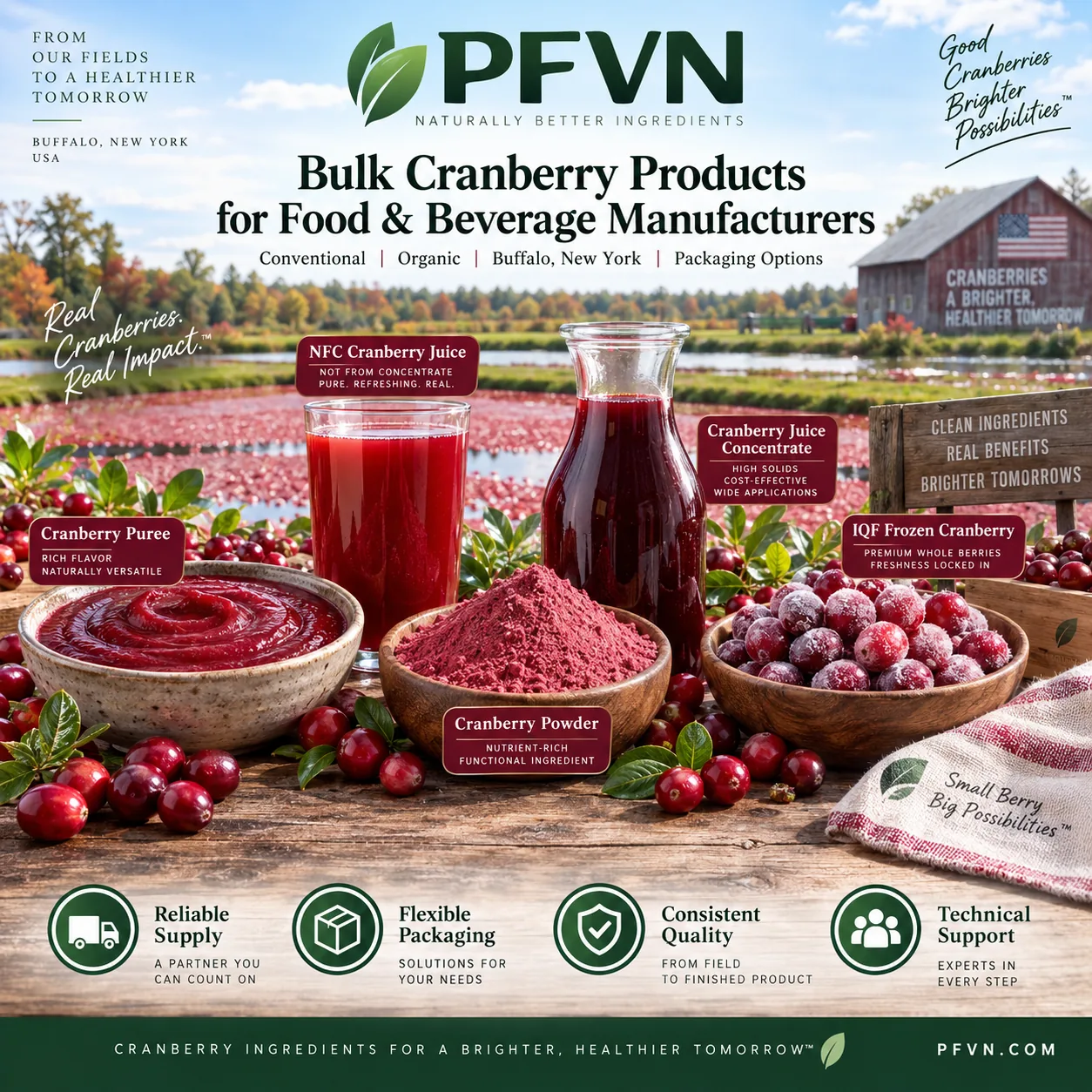
Cranberry Very tart red-fruit profile

Cranberry contributes high acidity and strong red-fruit character. It is useful in cranberry-orange, apple-cranberry, seasonal pastry and sweet-savory bakery concepts.

Commercial formats include approximately 50° Brix and 65° Brix products. A representative 50° Brix concentrate may have pH around 1.0–2.9 with a single-strength reference near 7.5° Brix.

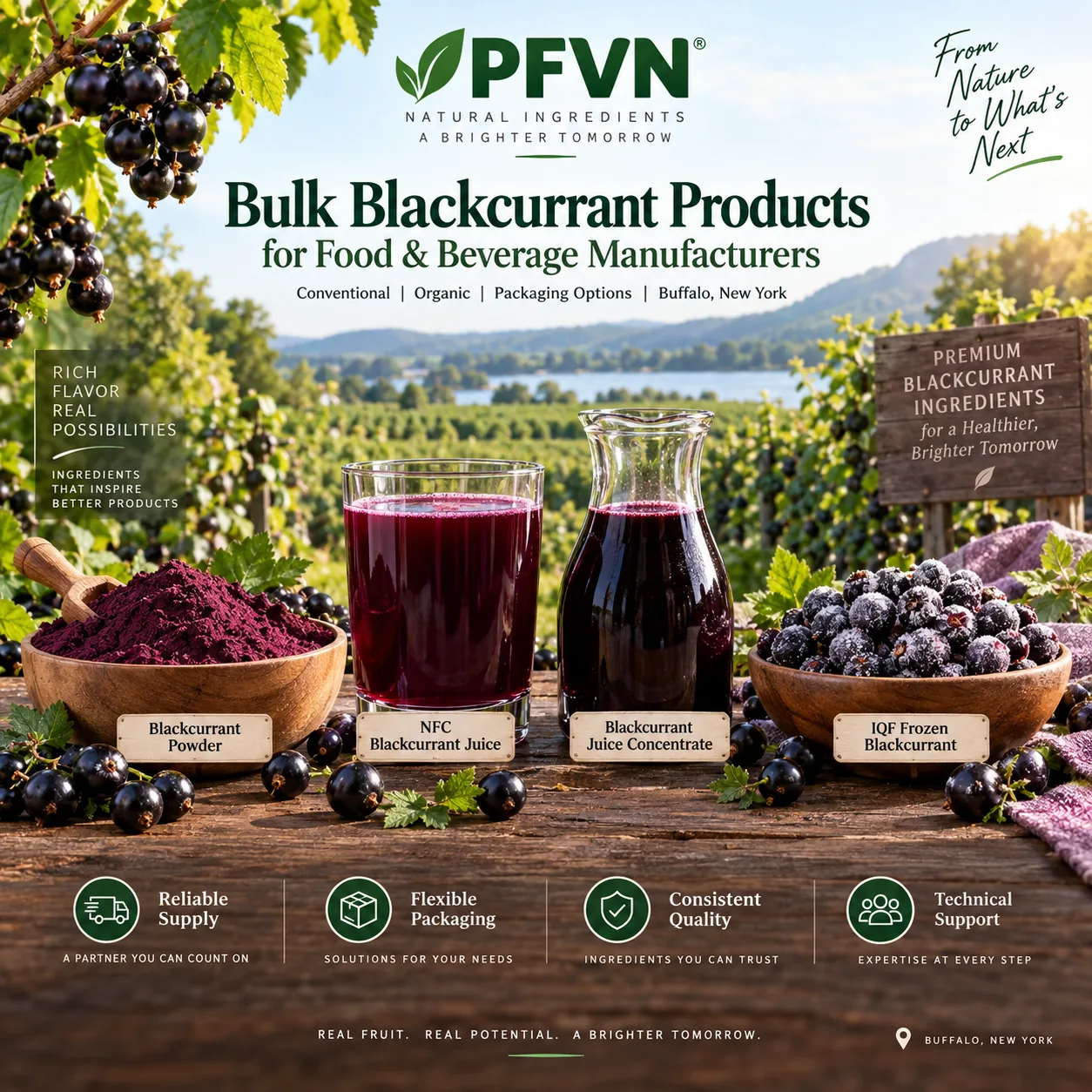
Blackcurrant Intense dark berry & high acidity

Blackcurrant provides strong aromatic character, dark red-purple color and pronounced tartness. It can add substantial fruit impact at relatively modest inclusion rates.

Representative concentrate is around 65° Brix, pH approximately 2.2–3.6, with a single-strength reference near 11° Brix.

Elderberry Dark fruit color & softer aromatic profile

Elderberry provides deep fruit color and dark-berry character that can complement blueberry, blackberry, apple, cherry and spice-oriented bakery systems.

A representative concentrate is around 65° Brix, pH approximately 3.4–4.8, with a single-strength reference near 11° Brix.

Commercial note: High-acid fruits require particular attention to acid-corrected Brix, titratable acidity and finished formulation balance. Use the current supplier specification and COA rather than assuming every concentrate with the same nominal Brix will perform alike.
Technical specification

Translate fruit identity into measurable purchasing criteria

Brix is important, but it is only one part of concentrate qualification. Bakery performance depends on the complete combination of solids, acid profile, color, flavor and processing conditions.

  • Direct °Brix: defines the nominal soluble-solids concentration.
  • Acid-corrected Brix: useful for highly acidic berry and cranberry concentrates where acids influence refractometer readings.
  • Titratable acidity: helps predict how strongly the concentrate will affect finished sweet-tart balance.
  • pH: useful for raw-material control and ingredient interactions, although the complete filling should be evaluated separately.
  • Specific gravity: useful for weight-to-volume calculations and liquid metering.
  • Color: especially important for cherry, cranberry, blackcurrant, elderberry and dark berry systems.
  • Flavor / aroma: should be characteristic of the fruit and free from objectionable fermented, scorched, caramelized or oxidized notes.
  • Clarity / insoluble solids: important where a smooth filling or fine injection system is required.
  • Microbiological specification: should fit the manufacturer's process and quality program.
Format selection

Concentrate, puree and IQF fruit serve different purposes

Many commercial fillings use more than one fruit format to achieve the required flavor intensity, body and visual identity.

Concentrate Flavor & soluble solids

Provides concentrated fruit flavor, acidity and soluble solids while adding comparatively limited water.

Puree Body & pulp

Adds insoluble fruit material, texture and body that clarified juice concentrate normally does not provide.

IQF fruit Visible fruit pieces

Provides recognizable pieces for premium, rustic and high-fruit bakery presentations.

Powder Dry-system flexibility

Useful for dry mixes, doughs, coatings and applications where adding liquid is undesirable.

Formulation

Use concentrate to build solids without unnecessary water

One of the main advantages of juice concentrate in bakery fillings is its high solids-to-water ratio. Instead of fully reconstituting the juice, the concentrate can usually be metered directly into the filling formulation.

This can reduce the amount of water that must later be evaporated while increasing fruit flavor, acidity and soluble solids.

Track the complete solids balance

The concentrate is only one contributor to finished filling Brix. Sugar, glucose or other syrups, puree, starch, fibers and additional liquids also affect total solids.

Conceptual calculation:
concentrate mass × concentrate Brix fraction = approximate soluble solids contributed by the concentrate.

Final commercial formulation should use actual lot analytical values and a complete mass balance rather than this simplified relationship alone.

Major industrial applications

Where juice concentrates fit in bakery manufacturing

Concentrates can support both smooth industrial fillings and multi-component fruit preparations containing puree or visible fruit pieces.

Pies Pie & hand-pie fillings

Concentrate can intensify fruit flavor in a filling built with puree, pieces, starch and sweeteners while limiting extra water.

Pastry Danish, turnovers & croissants

Concentrates can strengthen fruit flavor and color in bake-stable centers where the filling must remain controlled during proofing and baking.

Doughnuts Post-bake injected centers

Clarified concentrate can work well in smooth injectable fillings where fruit impact is needed without additional pulp or large particles.

Cookies Filled & sandwich cookies

High-solids concentrate can support dense fruit centers while the complete filling system controls water activity and moisture migration.

Bars Fruit bars & breakfast bars

Berry and cherry concentrates can provide concentrated flavor, acidity and color within dense cereal or bakery matrices.

Cakes Cake layers & fruit ribbons

Concentrates can be used in cake fillings, ribbon systems and fruit layers where strong flavor is required at relatively low liquid addition.

Cheesecake Swirls & toppings

Raspberry, blueberry, blackberry and cherry concentrates can intensify fruit preparations used in cheesecake swirls, toppings and layers.

Glazes Bakery toppings & stripes

Concentrate can contribute flavor and plant-derived color in glazes, fruit stripes and surface preparations where smooth texture is desired.

Pre-bake performance

Qualify the complete filling through the oven cycle

Baking can concentrate sugars and acids, reduce volatile fruit aroma, change plant pigments and increase steam pressure within the filling.

A concentrate that tastes excellent before baking should therefore be approved again after the actual oven cycle and after cooling.

  • Filling leakage
  • Boiling and expansion
  • Post-bake viscosity
  • Flavor retention
  • Color change
  • Water loss
  • Position within the bakery product
  • Dough or pastry interface
Moisture & texture

Concentrate reduces water input but does not replace filling structure

A juice concentrate can improve the solids-to-water ratio, but the complete filling still needs a rheology and water-binding system appropriate to the bakery process.

Starch Build viscosity & bake stability

Starches may be selected for acid tolerance, shear resistance, bake stability and freeze-thaw performance.

Pectin Structured fruit texture

Pectin performance depends on pH, soluble solids, calcium, sugar concentration and thermal process.

Syneresis Control free-water release

Water separation can create wet pastry surfaces, package staining and filling instability.

Moisture migration Protect crisp bakery texture

Water movement between filling and pastry can soften cookies or crusts and change filling texture during storage.

Water activity Evaluate the finished product

Water activity is different from total moisture and should be assessed within the complete filling and assembled bakery product.

Freeze-thaw Validate frozen programs

Frozen bakery products should be evaluated for syneresis, viscosity, color, flavor and dough-interface changes after thawing or bake-off.

Food-safety note: High Brix, low pH, baking, refrigeration, freezing or preservative use should not individually be assumed to establish finished-product safety or shelf life. Validate the complete formulation, process, packaging and storage system.
Color & sensory stability

Approve fruit character after processing

Dark berries and cherries can provide substantial plant-derived color, but pigment appearance can change with pH, heat, oxygen, light and storage.

Fruit aroma can also become less intense during baking as volatile components are lost. Highly aromatic or high-acid fruits may therefore behave differently from softer berry or sweet-cherry systems.

Evaluate at multiple stages

  • Incoming concentrate
  • Prepared filling
  • After cooking
  • After baking
  • After cooling
  • Throughout packaged storage
Commercial handling

Pails, drums and frozen concentrate programs

Commercial berry and cherry concentrates are frequently available in polyethylene pails and lined steel drums. Exact package weight, processing format and storage conditions vary by fruit and supplier.

Pails Development & smaller production

Pail programs can simplify trials and smaller production runs where full drums would create unnecessary opened-container residual.

Drums Commercial production

Lined drums are widely used for high-Brix berry and cherry concentrates in industrial production.

Frozen supply Plan thawing and tempering

Many high-Brix fruit concentrates are supplied frozen. Confirm freezer capacity, thawing instructions and post-thaw handling for the exact product.

Crystallization Possible in high-solids fruit

Selected cherry, cranberry and elderberry concentrates may crystallize during cold storage. Follow supplier instructions for controlled warming and agitation where applicable.

Commercial sourcing

Compare concentrate on usable fruit solids, not price alone

Concentrates with different Brix and acidity should not be compared only on delivered price per pound. Required use rate, solids contribution, storage, freight and line handling can materially change total formulation cost.

  • Nominal and corrected Brix
  • Titratable acidity
  • Required inclusion rate
  • Net pack weight
  • Frozen or other storage requirements
  • Thawing and handling labor
  • Freight
  • Package residual
  • Production yield
  • Supply continuity
Scale-up

Move from bench formulation to commercial bakery equipment

Larger production systems introduce longer holding times, different heat-transfer rates, higher shear and tighter deposit-weight requirements. The approved concentrate should be evaluated through the entire production sequence.

Receiving Verify incoming material

Confirm lot, Brix, pH or acidity where required, sensory condition, packaging integrity and COA compliance.

Mixing Control addition sequence

Confirm that concentrate distributes evenly without localized high-acid, high-color or high-solids zones.

Pumping Account for high-Brix viscosity

Concentrate viscosity changes with temperature. Validate pump type, hose diameter, transfer distance and unloading method.

Depositing Maintain portion accuracy

Monitor filling temperature, finished viscosity, depositor pressure and deposit weight.

Oven Confirm thermal performance

Evaluate leakage, fruit aroma, color, water loss and filling position under commercial baking conditions.

Storage Test the assembled product

Evaluate flavor, color, syneresis, moisture migration, bakery texture and package integrity over the intended shelf life.

Troubleshooting

Common concentrate-related development issues

Sensory

Fruit flavor becomes weak after baking

Review concentrate inclusion rate, heat exposure, fruit selection, sweetness and competing flavors. Approve sensory performance after the full oven cycle.

Acidity

Filling tastes too tart

Review concentrate titratable acidity, use rate, added acids, sweetener level and final filling Brix.

Sweetness

Filling tastes too sweet

Review concentrate Brix, added sweeteners, puree contribution and whether the fruit acid level is sufficient for balance.

Color

Berry color fades or darkens

Check pH, heat exposure, oxygen incorporation, holding time and interaction with other ingredients.

Processing

Concentrate is difficult to pump

Review product temperature, Brix, viscosity, pump selection, transfer distance and supplier handling guidance.

Batch control

Finished Brix varies

Check incoming concentrate Brix, weighing accuracy, added water, batch mixing and analytical sampling procedures.

Relevant products

Juice concentrates to review for bakery programs

These PFVN catalog products are practical starting points for fillings and inclusions. Final suitability depends on the exact supplied specification, formulation and manufacturing process.

Start a project

Source juice concentrates for your bakery program

Tell PFVN which bakery product you are developing, the fruit concentrate required, target Brix and acidity, flavor and color objectives, whether the filling is pre-bake or post-bake, packaging preference, storage requirements, trial quantity, annual volume and delivery destination.